Orthognathic surgery in Quito: what it is, when you need it and what recovery looks like
If you’ve been told you might need orthognathic surgery and you’re not quite sure what that means, you’re not alone. It’s one of those procedures that sounds far more complicated than it actually is once you understand what it’s for and when it’s recommended. Here’s what you need to know: what it is, who needs it, how the process works from start to finish, and what to expect during recovery.
What is orthognathic surgery?
Orthognathic surgery is a surgical procedure that corrects irregularities in the jaw bones — the upper jaw, the lower jaw, or both — when they’re not properly aligned with each other. It’s not about moving teeth, the way orthodontics does; it’s about repositioning the bones that support them.
When the upper and lower jaws don’t fit together correctly, it can affect how you bite, how you speak, how you breathe, and even your facial symmetry. In many cases, orthodontics alone isn’t enough to fix the problem, because the root cause isn’t in the position of the teeth but in the bone structure underneath them. That’s why this procedure is usually handled jointly by an orthodontist and a maxillofacial surgeon.
When is this type of surgery recommended?
There are several signs that typically lead a patient to seek a consultation:
- Severe bite problems, such as an open bite, crossbite, or a noticeable mismatch between the upper and lower jaw.
- Difficulty chewing or biting food normally, even after orthodontic treatment.
- Pain or dysfunction in the temporomandibular joint (TMJ), which in some cases is directly linked to jaw misalignment.
- Breathing problems during sleep, including cases of sleep apnea related to jaw position.
- Noticeable facial asymmetry that affects both function and appearance.
- Cases where orthodontics alone doesn’t solve the problem, and the orthodontist refers the patient for surgical evaluation.
This isn’t a cosmetic procedure in the traditional sense, although it often does improve facial harmony as a result of correcting function. The decision to operate always starts from a diagnosed functional need, not a preference for appearance — which is why the first consultation is what determines whether surgery is really the right path for each case.
According to Dr. Fernando José Sandoval Portilla, oral and maxillofacial surgeon, one of the most common mistakes is that patients arrive at the consultation assuming their case is purely cosmetic, when in reality there’s an underlying functional issue explaining discomfort they’ve had for years — things like difficulty chewing on one side or recurring jaw pain. He recommends not ruling out an evaluation just because the problem “doesn’t look that serious” at first glance.
How does the process work, step by step?
- Evaluation and diagnosis. Everything starts with a complete clinical assessment, typically supported by imaging such as 3D tomography, which allows the surgeon to see exactly how the bones are positioned and plan the surgery with precision before ever touching the patient. This stage also rules out other possible causes of the patient’s symptoms.
Dr. Fernando José Sandoval Portilla recommends taking this diagnostic phase seriously and not rushing through it, precisely because precise 3D imaging planning reduces surprises during surgery and helps anticipate the final outcome with far more certainty than was possible years ago, before this technology was available.
- Orthodontic preparation. In most cases, a period of orthodontic treatment is needed beforehand to align the teeth within each jaw separately, before surgery corrects the position of the bones. This step can take several months, and it’s normal for the bite to feel slightly worse before it gets better during this phase, since the groundwork is being laid for the surgery.
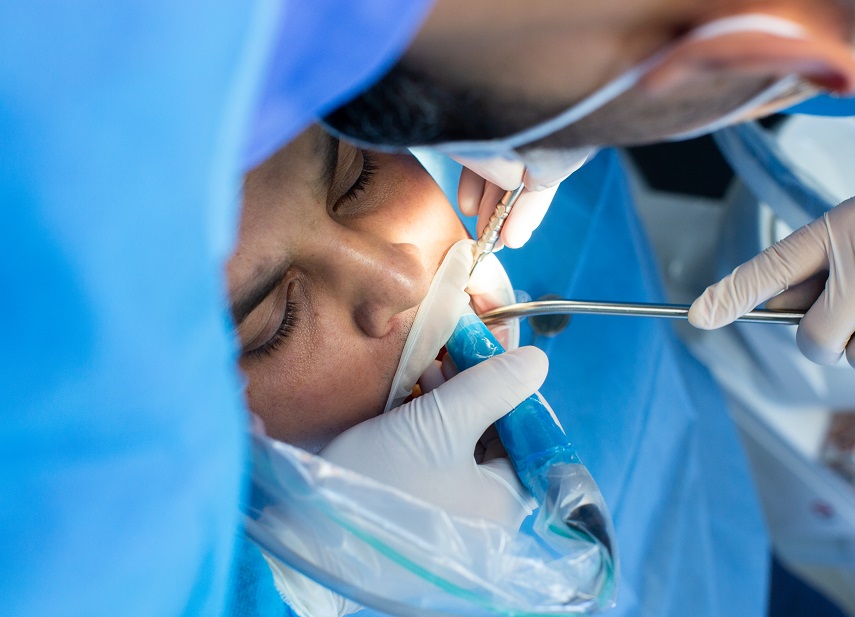
- The surgery. It’s performed under general anesthesia, usually with a hospital stay of one to a few days depending on the complexity of the case. The surgeon repositions the upper jaw, the lower jaw, or both, and secures them with plates and screws that remain permanently in place, allowing the bone to heal in its new position.
- Post-surgical orthodontics. After surgery, there’s usually a final round of orthodontic adjustment to fine-tune the bite once the bones are in their new position and beginning to consolidate.
What does recovery look like?
Recovery happens in stages, and it’s important to have realistic expectations from the start. The first week typically involves noticeable swelling, some discomfort managed with medication, and a liquid or soft diet while the surgical area begins to heal. Most patients return to light daily activities between the second and third week, although full swelling can take a bit longer to go down completely.
Full functional recovery — normal chewing, sensation, complete bone healing — takes several months, since the bone needs time to fully consolidate in its new position. It’s a gradual process, not something that resolves in a couple of weeks, which is why close follow-up with the surgeon throughout this period is essential for catching and addressing any issues early.
According to Dr. Fernando José Sandoval Portilla, the most important piece of advice during this stage is not to compare your own recovery timeline to that of other patients, since every case heals at a different pace depending on its complexity. He suggests keeping communication open with the surgeon whenever a concern comes up, rather than waiting until the next scheduled check-up to mention it.
Why does it matter that a maxillofacial surgeon performs this procedure?
Orthognathic surgery isn’t performed by a general dentist or an orthodontist — it’s a procedure that falls specifically under oral and maxillofacial surgery, a specialty trained to operate on bone, joints, and complex facial structures, and to manage any surgical complications that may arise during the process. An orthodontist’s training focuses on tooth movement; a maxillofacial surgeon’s training focuses on bone and soft tissue surgery across the entire facial region.
Clínica Odontológica Fernando Sandoval offers this service at both of its locations, Quito and Cumbayá. At the Cumbayá location, these cases are evaluated and operated on directly by Dr. Fernando José Sandoval Portilla, an oral and maxillofacial surgeon with postgraduate training from the National Autonomous University of Mexico (UNAM) and clinical externships in maxillofacial surgery at universities in the United States. His clinical practice includes, in addition to orthognathic surgery, the management of dentofacial deformities, temporomandibular joint disorders, maxillofacial trauma, and jaw pathology.
Frequently Asked Questions
Is orthognathic surgery painful?
Like any major surgery, it involves a period of discomfort and swelling, especially during the first week, but it’s managed with prescribed medication and gradually decreases throughout recovery.
How long does full recovery take?
Initial functional recovery takes about two to three weeks, but complete bone consolidation can take several months, depending on the complexity of the case.
Do you always need orthodontics before and after surgery?
In most cases, yes — orthodontics aligns the teeth within each jaw before surgery, and fine-tunes the bite afterward once the bone position has been corrected.
Who should perform this type of surgery?
It should be performed by an oral and maxillofacial surgeon, a specialist specifically trained to operate on jaw bones and facial structures — not a general dentist or an orthodontist.
Where can I get evaluated for orthognathic surgery in Quito or Cumbayá?
Clínica Odontológica Fernando Sandoval offers this service at both locations. In Cumbayá, evaluation and surgery are performed directly by Dr. Fernando José Sandoval Portilla, oral and maxillofacial surgeon.
Conclusion
Orthognathic surgery isn’t a procedure to take lightly, but it also shouldn’t be a source of fear when it’s properly planned and performed by a specialist specifically trained for it. With the right diagnosis and close follow-up, it’s one of the interventions that has the most genuine impact on a patient’s quality of life, beyond the cosmetic result.